
Vibratory Needle Test Device
&
High Frequency Mechanical Oscillator

Project Overview
Our client is developing a new method for needle biopsies where the traditional “cork bore” style needle is replaced by a vibrating needle. The intent is to develop a safer and less traumatic means of extracting the tissue. We were contracted to develop a testing device for comparison studies.
The Challenge
This project required a very fast development time over the holidays, a total of 3 weeks was spent from the initial meeting to finished and tested unit. Other complexities included filtering noise created from the vibrator from the load cell signal, as well as the nearly 1 hp of power required from the motor.
Our Solution
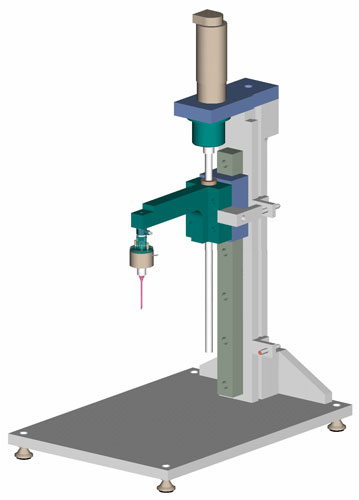
We designed a testing device that would provide a means of holding a tissue sample (rabbit or similar test subject), a vertical axis to provide controlled distance, velocity and acceleration, and a load cell to measure force on the needle. The device, including all parts, were manufactured in-house.
%
Product Design
%
Manufacturing
Day Turnaround
Amazing Result
Designed to Exceed Expectations
Built for Studies
Used for studying biopsy processes, comparing traditional methods to the new method.
User-Focused
We created three sets of gears to provide different ratios that the user can change out.
Optimized for Performance
Three sets of cranks were added to achieve 5º, 10º, and 15º oscillations.
Noise Reduction
We developed a low pass filter using digital filtration VI’s within Lab View to reduce noise.
Special Requirements
The High Frequency Mechanical Oscillator was intended to allow a higher range of motion and frequency beyond the solenoid oscillator used previously. It consists of a crank mechanism, which resembled eccentric cams, and a nickel bronze connecting linkage. This mechanism is driven by an AC servo motor with gearing to increase speed.
Built for Power
The maximum frequency achieved was around 1500 Hz, which required nearly 1 hp from the motor. All of the power required was due to dynamic forces. The linkage required several design changes to minimize mass and maximize strength while using the strongest bronze alloy just so the linkage would not break at the highest attainable speed.
Final Touches
The needle was supported by a bearing set that would shift in and out of drive position by a positive clutch that could be operated by a knob. A load cell measured the penetrating force. The control for the device was an AC servo amplifier that was integrated into the existing I/O module and the LabView front end software was updated for the new additions.